Acoustic Panels vs. Soundproofing: Why Foam Squares Won't Block Noise
This is the single most common point of confusion in soundproofing, and it’s the reason so many people buy a $150 foam panel kit, mount it on their wall, and are disappointed a week later when they can still hear their neighbor’s TV. The panels aren’t defective; they’re just built for a different job than the one being asked of them.
Two different problems, two different fixes
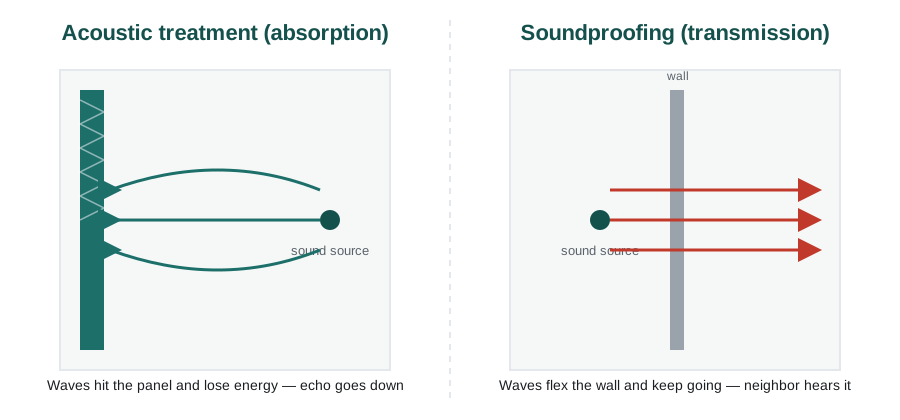
Acoustic treatment (what foam panels do): controls how sound behaves inside a room: echo, reverb, that “boomy” or “harsh” sound in a room with hard floors and bare walls. It doesn’t stop sound from leaving or entering the room.
Soundproofing (what foam panels don’t do): blocks sound from passing through a wall, floor, ceiling, or door. This requires mass, and often decoupling (physically separating layers so vibration can’t travel straight through).
If your problem is “this room sounds echoey and my voice sounds harsh on video calls,” you need acoustic treatment. If your problem is “I can hear my neighbor” or “my neighbor can hear me,” you need soundproofing, and foam panels contribute almost nothing to that.
How to tell which one you actually have
Ask yourself: is the noise problem happening inside the room you’re in, independent of anyone else, or is it about sound crossing a boundary between two spaces?
- Your own voice echoing back at you on a call → acoustic treatment
- Music sounding harsh or “live” in a bare room → acoustic treatment
- Hearing a neighbor’s conversation → soundproofing (transmission)
- Someone complaining they can hear you → soundproofing (transmission)
- Footsteps from the unit above → soundproofing/impact noise, different fix again (see our room-by-room noise guide)
Most people actually have a mix of both if they’re in an apartment with a home office: bad room acoustics for calls, plus a transmission problem with the neighbor. That means two separate purchases solve two separate parts of the problem, so don’t expect one product to fix both.
Reading the rating, not the marketing
The number that actually tells you what a soundproofing product does is its STC (Sound Transmission Class) rating, not the thickness of foam or how “professional” the packaging looks.
| STC rating | What it means in practice |
|---|---|
| 25-30 | Typical single stud wall with drywall: loud speech is clearly audible |
| 35-40 | Normal speech barely audible, loud speech audible |
| 45-50 | Loud sounds heard only faintly |
| 50+ | Approaching professional studio isolation |
A product listing that doesn’t mention STC or NRC at all, just “blocks noise” or “soundproof” in the name, is a marketing claim, not a spec. Look for the actual number before buying, and be skeptical of anything advertising a “100% soundproof” result; no consumer product achieves that.
What to actually buy for each problem
For acoustic treatment (echo/reverb):
- Acoustic foam panels or fabric-wrapped fiberglass panels, rated by NRC (look for 0.7+ for meaningful absorption)
- A rug on hard flooring
- Bookshelves (irregular surfaces break up reflections even without a formal NRC rating)
For soundproofing (blocking transmission):
- Mass-loaded vinyl (rated by STC when combined with a wall assembly)
- Door sweeps and weatherstripping for gap sealing
- Added mass via furniture placement (see our apartment wall guide)
Buying the right category for your actual problem is the difference between a fix that works and a room full of foam that just looks like it should.
Frequently Asked Questions
Are acoustic foam panels a waste of money?
Not if you use them for the right problem. They're effective and inexpensive for reducing echo and reverb inside a room: home studios, offices with hard floors, rooms that sound 'boomy.' They're a waste of money if you're buying them expecting to stop noise from a neighbor or the street, which they aren't designed to do.
What's the difference between NRC and STC ratings?
NRC (Noise Reduction Coefficient) measures how much sound a material absorbs inside a room, on a scale of 0 to 1. This is what matters for echo control. STC (Sound Transmission Class) measures how much a material blocks sound from passing through it, usually on a scale from around 25 (poor) to 60+ (excellent). This is what matters for blocking noise between spaces.